Friday, 12 October 2012

Maya: Pencil & Eraser

Friday (05/10/12) we were given a tutorial on how to create two characters; a pencil and an eraser. Below is a screenshot of my finished pencil; I ran into a few problems with some of the newer techniques, but overall felt quite comfortable with the program. 

Pencil

Eraser to follow. 

Sunday, 7 October 2012

Thumbs 01 - 09

Thumbnails 1 to 9 for The Magic Shop (1903) by H.G Wells.
These thumbnails are for the Magic Shop front,figuring out the focus and the perspective of the image. 


Life Drawings 02/10/12

On Tuesday(02/10/12) I had my second life drawing lesson, this lesson focused on the negative space around the model.

Negative space using one line drawing
Negative Space


Negative space & detail

Friday, 5 October 2012

Cinematic Spaces: Influence Maps

Below are the Influence Maps from my two books by H.G Wells:
The Red Room (1896)
The Magic Shop (1903) 
These images have been gathered to help direct my thumbnails and to draw inspiration from for perspective or ideas. 

Cinematic Spaces Film Reviews: Metropolis


Metropolis (1927) was directed by a German man named Fritz Lang but was written by Lang and his wife, Thea Von Harbou. Metropolis is considered to be one of the most influential films in regards to special effects and the boundaries it pushed in film making; considering Metropolis was only made 7 years after Cabinet of Dr. Caligari (1920) you can see how far film making and the process behind it had come in that short space of time. Whereas previous films had used a theatrical stage as their set, which gave them limited space and gave the films a theatre look, Metropolis used bigger sets and bigger spaces to create a film that looked as if it was set in a real world scenario.
Fig 1
One of the main characteristics to notice in Metropolis is the use of height in the buildings. ‘The great city of Metropolis, with its stadiums, skyscrapers and expressways in the sky, and the subterranean worker's city, where the clock face shows 10 hours to cram another day into the work week.’ Ebert. This quote, along with the image above helps to demonstrate and show how Lang used the infrastructure of the buildings, as if to symbolise the power of industrialism and the insignificance of the workers and the ‘middle class’ citizens. The buildings used throughout the film have a sense of Classicism to them in the way they use clean edges and simplistic designs, but it is used in a way to almost squash the characters and make them seem so much smaller than they actually are. This also ties in with the broken will that is portrayed throughout the beginning of the film; since the storyline is based around social classes and the workers being forced to work obscene shifts underneath the city, the use of structure ties in with the themes and motifs well.

Fig 2

The image above is another way in which Lang used height and structure to convey the power and the dominance the ‘upper class’ had in comparison to the workers below the Earth’s surface; the building in figure 2 is the building in which Joh Fredersen overlooked the city. ‘Metropolis, the futuristic city, is a barometer for class warfare with the effete rich enjoying creature comforts high in the sky while the beaten down workers toil in an underground dystopia of purposeless machines and skull-filled catacombs.’ Brenner, (2011).


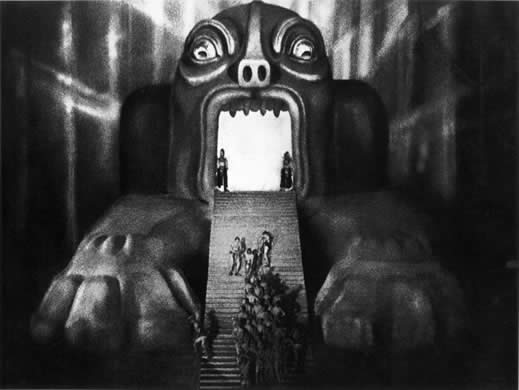
Another one of the more famous aspects of Metropolis was its use of effects throughout the film to create vivid and threatening mirages that Freder witnessed and became traumatised by.
Figure 3 is a film still from the main machine featured in the workers area; when the machine blows and workers are injured and killed, a series of film was played that showed the machine open up and the workers fall into the pits of the mouth while the other march in unison to their fate. The use of the buildings and the daunting face on the machine created a sequence of film that was both disorientating and helped to convey the message of the film. ‘when the machinery explodes, Freder has a vision in which the machinery turns into an obscene devouring monster.’ Ebert.
The use of height in structure is again evident in the workers underground city, even more so to help show the dominance that Joh Fredersen had over the city and to carry through the message of power. 


Bibliography
Images
Film Still 1 (Fig 1) http://davidszondy.com/future/city/Metropolis%2001.jpg 

Quotes
Robert Ebert. In: http://www.ebertfest.com [online] At: http://www.ebertfest.com/four/metropolis_silent_rev.htm (Accessed on 04/10/12)
Paul Brenner. In: http://movies.amctv.com [online] At: http://movies.amctv.com/movie/1927/Metropolis (Accessed on 05/10/12)
Robert Ebert. In: http://www.ebertfest.com/ [online] At: http://www.ebertfest.com/four/metropolis_silent_rev.htm (Accessed on 05/10/12)  


Monday, 1 October 2012

Cinematic Spaces Film Reviews: The Cabinet of Dr. Caligari


The Cabinet of Dr. Caligari (1920), is considered to be one of the most influential silent horror films to be made. Directed by Robert Wiene, the film used quirky and strange settings and scenes to help create ambiance and tension throughout the film to help the audience react with the horror aspect. Although the film is in black and white, the use of different shades and intensities of light helps to create different dynamics in the scenes and helps to emphasise the different moods throughout the film.

‘Cagliari’s Expressionist style ultimately led to the dark shadows and sharp angles of the film noir urban crime dramas of the 1940s’ (Erikson,2010)

Fig 1
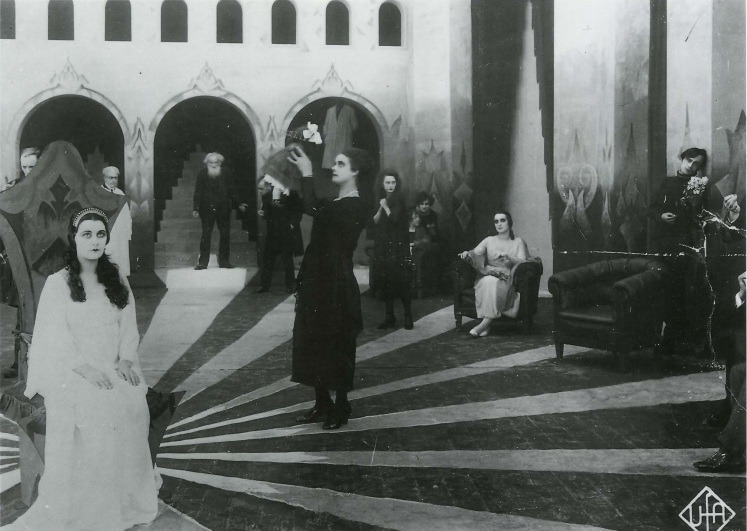
Figure 1 works well to show what Hal Erikson was saying about the sets and scenes used in the film. Wiene wanted to create a surreal yet horror related set that would help to create and carry the tension of the film and capture the audience’s attention; the use of jagged edges and sharp shading created an edgy and horror-type setting. Wiene also managed to create a set that allowed them to create some interesting camera shots, as shown in figure 1, the use of walling and shapes helps to frame certain scenes and gives the film a certain theatrical feel.

‘In particular, in many scenes, the shadows were actually painted onto the set, such that, in certain scenes, the shadows lie in direct defiance of natural lighting.’ (Merriam, 2008)

Fig 2
One of the other notable aspects of the scenes and sets used in Caligari was the odd use of shadowing that was painted onto the floors and walls of the set pieces. Much like Julia Merriam said, they were painted in a way that was in direct defiance of natural lighting; whilst the natural shadows were evident from lighting used for the film, the painted shadows never wavered or changed; they created a sense of depth to each set and exaggerated just how big the sets were to create a much more spacious and eerie looking area.

‘Verticality is rare in Cabinet; its buildings rest at steep angles, as though they are leaning. It’s streets wind and weaves in organic fashion.’ (Edwards, 2010)

Fig 3
Figure 3 shows all the aspects of the set design brought into one final image; the use of jagged shapes to create odd looking buildings and create a set that would intrigue and capture the audience’s attention whilst adding to the dynamics of the film; the use of contrasting lights to create an almost silhouetted figure stood atop the building to help build the tension and suspense of the film. It was Wiene’s unique set designs and lighting structures that create a film that is still regarded as the beginning of horror films and his influences can be seen throughout various set designs and structures. 


Review Bibliography 
Quotes:
Hal Erickson (2010). In: http://www.rottentomatoes.com [online] At: http://www.rottentomatoes.com/m/1003361-cabinet_of_dr_caligari/  (Accessed on 20/9/12)
 Julia Merriam (2008). In:  http://classic-horror.com [online] At: http://classic-horror.com/reviews/cabinet_of_dr_caligari_1920 (Accessed on 30/9/12)
Chris Edwards (2010). In:  http://silent-volume.blogspot.co.uk [online] At: - http://silent-volume.blogspot.co.uk/2010/04/cabinet-of-dr-caligari-1920.html (Accessed on 30/9/12) 


Images:

Film Still 1 (Fig 1)